
Table of Contents
- What Are Modern Browser-Native Games?
- By the Numbers: Market Trends & Player Behavior (2025–2026)
- Standout Browser-Native Hits (2025–2026)
- Why Browser Games Are Exploding in 2026
- Industry Challenges: Headwinds Facing Web Developers
- What’s Next for Web-Native Gaming?
- Final Thoughts
- FAQ:Browser Games 2026
If you still picture browser games as low-res, short-lived Flash titles from the 2000s, you are overlooking one of the gaming industry’s fastest-growing segments.
Powered by HTML5, WebAssembly (Wasm), and WebGPU, modern free browser games now deliver fluid multiplayer competition, persistent strategy loops, and rich 3D graphics—with zero downloads, zero app-store approvals, and instant access straight from any web tab.
Industry data from 2025–2026 highlights shifting player habits, massive platform traffic, and a brand-new economic reality for indie studios building exclusively for the open web.
What Are Modern Browser-Native Games?
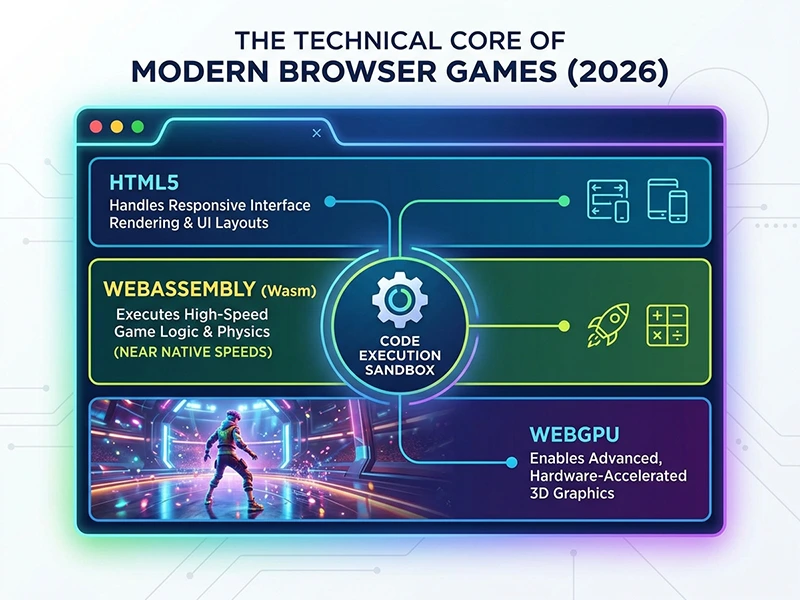
Unlike traditional software, browser-native games run entirely inside your web browser without requiring local installer files. They leverage core modern web standards:
- HTML5: Handles responsive interface rendering and UI layouts.
- WebAssembly (Wasm): Executes high-speed game logic and physics near native speeds.
- WebGPU: Enables advanced, hardware-accelerated 3D graphics rendering directly in the viewport.
Key Distinction: Browser-native games are NOT cloud-streamed titles like Xbox Cloud Gaming or NVIDIA GeForce NOW. Cloud gaming streams pre-rendered video feeds from remote servers. In contrast, browser-native games execute code locally within the browser sandbox. This ensures snappy, reliable performance even on moderate internet connections once initial assets are loaded.
Whether on a high-end desktop, a Chromebook, a tablet, or a mobile phone, players can jump into a session simply by clicking a URL. This frictionless entry point is the single biggest catalyst driving global adoption.
By the Numbers: Market Trends & Player Behavior (2025–2026)

Recent independent industry reports reveal a dramatic evolution in the modern web-gaming audience:
- Longer Play Sessions: A 12-month CrazyGames study (May 2025 – May 2026) analyzing 1.74 billion US browser sessions (totaling 862 million gameplay hours) revealed an average session time of 30 minutes—completely dismantling the legacy myth of 2-minute quick distractions.
- Mid-Week Engagement Spikes: Weekday traffic outpaced weekend usage by 22%. Thursdays recorded the highest session volumes, while Fridays saw the longest play durations as users wound down for the weekend. Hyper-casual titles accounted for 79% of total time played, while puzzle games dominated early-morning routines.
- Massive Audience Scale: Leading web-game platform Poki reached 100 million monthly active users (MAU) in 2026, up tenfold from 10 million in 2020. Competitor CrazyGames drew 61.1 million monthly visits, representing a staggering 673% growth over five years.
- Surging Titles Pipeline: Playgama market data logged 15,000 new HTML5 games launched globally during H1 2025 alone—nearly tripling H1 2024 release volumes.
- Mobile-First & Higher Monetization: The 2026 State of Web Gaming Report (Poki & Atomik Research) surveyed 2,000 US/UK consumers, finding that 37% play browser games multiple times per day, and 27% spend over $50 USD per month on in-game microtransactions. Crucially, 83% of monthly players access games primarily via mobile browsers.
- Monetization Benchmarks: Rewarded video ads remain the dominant revenue driver for creators. 2026 industry benchmarks put rewarded video eCPMs at $15–$28 for US audiences and $8–$15 for European users, dropping to $1–$3 in Tier-3 markets like Brazil and India.
Standout Browser-Native Hits (2025–2026)
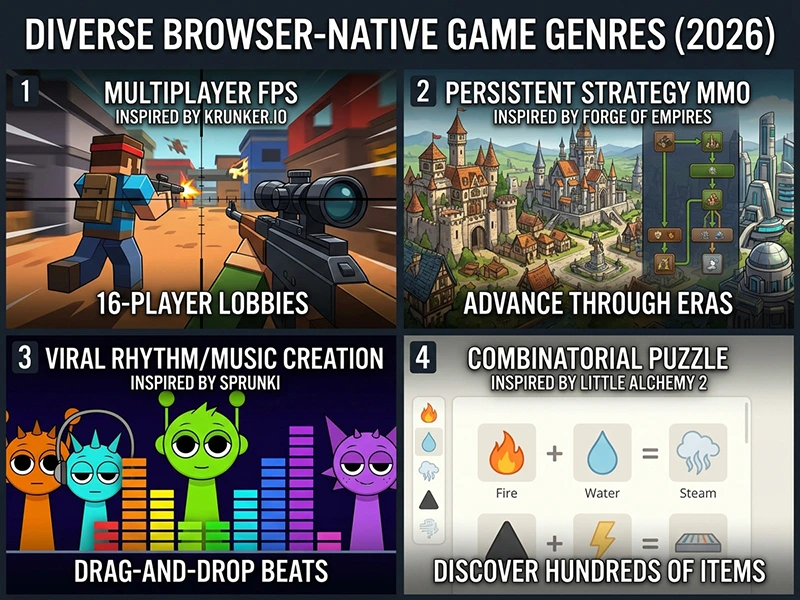
Today’s web-game ecosystem ranges from high-stakes multiplayer shooters to viral music sandbox titles. Here are real-world examples leading the space:
- Krunker.io (Multiplayer FPS)
One of the most enduring browser-native competitive shooters. Built on WebGL, Krunker supports fast-paced 16-player lobbies, custom community maps, and extensive modding. Players jump directly into matches via shareable links without mandatory downloads or logins. - Forge of Empires (Persistent Strategy MMO)
A flagship city-building strategy game where players advance through historical eras, research technologies, form guilds, and engage in tactical battles. It features seamless cross-device save synchronization and continues to hold a multi-million-strong active player base. - Sprunki (Viral Rhythm/Music Creation)
A viral indie breakout hit across 2025 and 2026. Sprunki allows players to combine drag-and-drop musical characters to create custom beats. Driven heavily by short-form video content on TikTok and YouTube Shorts, it proves how web games can achieve explosive organic growth without paid user acquisition. - Little Alchemy 2 (Combinatorial Puzzle)
A clean, creative puzzle game where players combine basic elements to discover hundreds of complex items. Designed with responsive touch controls, it performs flawlessly on both mobile devices and desktop browsers. - Venge.io (Fast-Paced Arena Shooter)
An intense 3D arena shooter leveraging WebAssembly for near-native performance. Features short rounds, character progression, and cosmetic unlocks. Match lobbies can be shared instantaneously via direct URLs.
Why Browser Games Are Exploding in 2026
Three core factors explain why developers and players are flocking back to the open web:
- Zero-Friction Access: No app store approvals, no 5GB downloads, and no storage constraints. This makes web games especially vital for users on low-storage mobile devices or restricted networks (e.g., school Chromebooks).
- True Cross-Platform Development: A single HTML5/WebGPU codebase automatically adapts to desktop mice, mobile touchscreens, and tablet interfaces—drastically cutting engineering costs compared to maintaining separate iOS and Android builds.
- Viral Link-Based Sharing: Inviting a friend to a native app requires an app store trip and an install step. Inviting a friend to a browser game requires sending a text or Discord link. One click drops the second player into the game instantly.
Industry Challenges: Headwinds Facing Web Developers
Despite unprecedented reach, developers operating on the open web face severe market pressures:
- AI-Generated Spam & Oversaturation: Tens of thousands of low-quality, AI-assembled hyper-casual clones have flooded web portals. This massive oversupply pushed average hyper-casual eCPMs down nearly 60% year-over-year.
- Privacy & Targeting Restrictions: Tighter browser privacy controls limit third-party ad tracking, reducing ad-targeting efficiency and ad yields.
- Fragmented Hardware Support: Although WebGPU became standard across modern browsers, legacy devices still require fallback rendering pipelines (like WebGL2) to avoid crashing.
- Discovery Bottlenecks: With over 15,000 games launching every six months, getting featured on curated portals like Poki or CrazyGames is harder than ever.
The Pivot: To survive, successful studios are moving away from ultra-simple “clicker” games toward “Web Mid-Core” titles—games with persistent saves, battle passes, and tactical progression loops that encourage long-term retention.
What’s Next for Web-Native Gaming?
The technology gap between native applications and the browser is closing rapidly.
- PWAs (Progressive Web Apps): Allow players to save web games to their mobile home screens, giving them offline access and an app-like presence without visiting an app store.
- WebXR Integration: Paves the way for lightweight, browser-based AR and VR experiences that run without dedicated platform installs.
- Universal Cloud Saves: Cross-device sync will allow players to start a session on a work desktop during lunch and seamlessly resume on their smartphone during their evening commute.
Final Thoughts
Browser gaming is no longer a temporary distraction or a remnant of the Flash era. Backed by solid market data, rapidly advancing web graphics APIs, and massive player counts, the browser tab has firmly established itself as a premier, universal gaming platform.
For players, the web eliminates entry barriers. For developers, it offers an un-gatekept direct line to global audiences. As the line between native apps and web capabilities continues to blur, the open web will remain gaming’s most accessible frontier.
FAQ:Browser Games 2026
Q1: What is the difference between browser‑native games and cloud‑streamed games?
Answer: Browser‑native games run game logic locally inside your browser using HTML5, WebAssembly and WebGPU. They only need internet to load initial assets and support multiplayer. Cloud‑streamed services such as Xbox Cloud Gaming and GeForce NOW stream video of pre‑built PC or console games to your browser tab; heavy computation happens on remote servers instead of your device.
Q2: Do browser games require downloads or app‑store installations?
Answer: True browser‑native games need no downloads or app‑store installs. Users open a URL in any modern browser and start playing immediately. Progressive Web App (PWA) shortcuts can be added to phone home screens, but this is not a full software installation.
Q3: What are the most popular browser games in 2025‑2026?
Answer: Standout titles include Sprunki, Forge of Empires, Little Alchemy 2, Venge.io and browser‑based FPS Krunker.io. They cover genres from rhythm creation and historical strategy to competitive shooters and creative puzzles.
Q4: How big is the browser‑game audience in 2026?
Answer: Top web‑game portal Poki hits 100 million monthly active players in 2026, while CrazyGames records roughly 61.1 million monthly visits. Research shows 83 % of browser‑game players access games primarily from mobile browsers, rather than desktop PCs. Average play sessions reach 30 minutes according to 2025‑2026 CrazyGames player data.
Q5: What technologies power modern browser games?
Answer: Core web standards include HTML5, JavaScript, WebAssembly for fast game logic, and WebGPU for advanced 3D graphics. Engines like Unity and Godot support exporting projects directly to these web‑native formats.