
Table of Contents
- 1. The Origin of Roguelike
- 2. Core Defining Traits of Traditional Roguelike (Berlin Interpretation Standard)
- 3. Roguelite: The Modern, Accessible Variant
- 4. Major Popular Roguelite Subgenres & Iconic Titles
- 5. Why Do Roguelike & Roguelite Games Stay Addictive?
- 6. Common Misconceptions
- 7. Final Thoughts
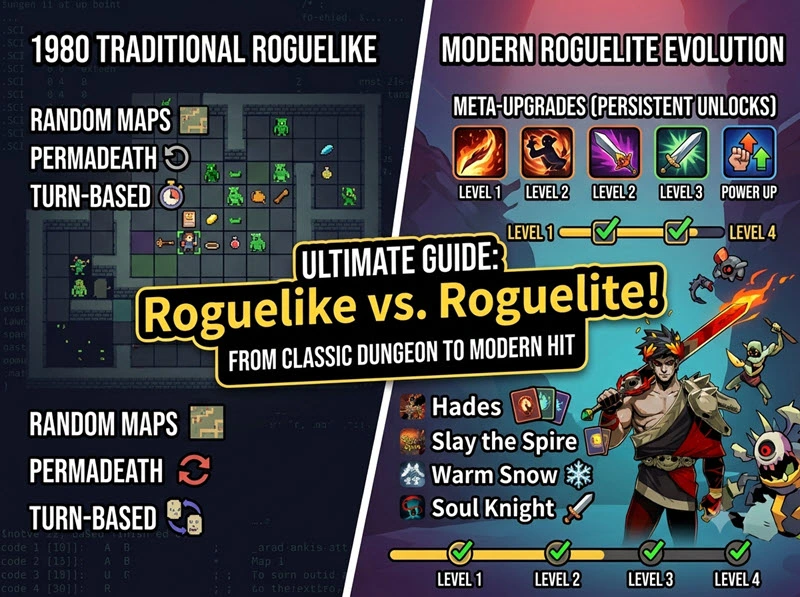
If you’ve heard gamers talk about “roguelike” or “roguelite” titles such as Hades, Slay the Spire and The Binding of Isaac, you may wonder what makes this game genre stand out from other RPGs and action games. The term roguelike stems from a landmark 1980 dungeon RPG named Rogue, which invented a set of revolutionary gameplay rules that spawned an entire game subgenre. Every run in a roguelike game feels fresh, risky and rewarding, thanks to its core design pillars: randomization, high-stakes exploration and unforgiving failure mechanics. Today, the category has split into two major branches-traditional strict roguelikes and modern accessible roguelites-each with clear differences in design philosophy.
The Origin of Roguelike
Released in 1980, Rogue is the foundational work of the genre. Unlike most fixed-level RPGs at that time, it used procedural generation to build unique tile-based dungeons every time players started a new game. It also introduced permadeath, a brutal rule where all character progress, loot and levels vanish permanently once the player’s character dies.
These two groundbreaking mechanics brought unprecedented unpredictability to dungeon crawling. As more independent games adopted similar systems, developers and players began calling them “roguelike” to honor the trailblazing Rogue. The original game used simple ASCII tile graphics and turn-based movement, features that became the baseline standard for classic roguelike titles.
Core Defining Traits of Traditional Roguelike (Berlin Interpretation Standard)
Based on the official industry definition and the glossary rules from Plarium, pure classic roguelike games must hit all the following key criteria:
1. Procedurally Generated Levels
No two playthroughs are identical. Maps, enemy spawns, item drops, secret rooms and dungeon layouts are randomly generated every run, eliminating repetitive fixed stages.
2.Permadeath (Permanent Death)
Death resets everything. There is no meta-progression, no persistent unlocks, no saved checkpoints to reload. If you lose, you restart completely from scratch with zero carried-over resources or power-ups.
3. Turn-Based, Tile-Based Gameplay
Characters move grid by grid, and every action consumes one turn. Combat and exploration rely on tactical planning instead of fast reflexes, prioritizing strategy over quick reactions. Early roguelikes used simple tile graphics for all environments and creatures.
4. Complex Dungeon Crawling & Deep Item Systems
Tons of loot, spells, consumables, equipment and unique artifacts spawn randomly, creating countless tactical combinations. Monsters, traps and environmental hazards add layered challenge to underground dungeon exploration.
5. Single Self-Contained Run Loop
Each play session is isolated. There is no cross-run advancement; your character’s strength only exists within the current dungeon run.
Roguelite: The Modern, Accessible Variant
| Feature | Traditional Roguelike | Roguelite |
|---|---|---|
| Permadeath Rule | All progress erased; zero cross-run rewards | Partial meta-progression survives death; unlocks carry over |
| Cross-Run Growth | No permanent unlocks, talents or characters | Persistent meta-upgrades: new weapons, heroes, passive buffs, story segments |
| Gameplay Style | Strict turn-based tile combat | Flexible formats: fast action, shooting, card building, platformers |
| Session Length | Long single runs (1–3 hours) | Short, replayable runs (20–60 minutes) |
| Difficulty Barrier | Extremely high, unforgiving for new players | Tunable difficulty, gentler learning curve for casual audiences |
Major Popular Roguelite Subgenres & Iconic Titles
The roguelite framework is incredibly flexible, blending with nearly every mainstream game style:
- Action Roguelites
Fast-paced real-time combat with randomized weapon and ability builds.
- Hades: Greek mythology-themed top-down hack-and-slash, widely regarded as the gold standard of roguelite design with rich story unlocks.
- Dead Cells: Side-scrolling soul-like dungeon crawler with random weapon affixes and branching biomes.
- The Binding of Isaac: Classic top-down bullet hell with hundreds of synergistic items.
- Risk of Rain 2: 3D third-person shooter with overpowering item stacking and online co-op.
- Deck-Building Roguelites
Strategy-focused card games where you draft random cards and relics each climb.
- Slay the Spire: The benchmark of card roguelites with deep tactical route choices.
- Balatro: Minimalist poker-based number roguelite with addictive scaling mechanics.
- Night of Full Moon: Popular Chinese indie card roguelite with dark fairy tale themes.
Why Do Roguelike & Roguelite Games Stay Addictive?
- Endless Replay Value
Procedural generation guarantees unique encounters, enemy layouts and item builds every time you launch a new run, so hundreds of hours of gameplay never feel repetitive.
- Unique Build Synergy Every Run
Random loot lets you craft wildly different playstyles. One run might focus on fast melee strikes, while the next builds a magic burst or ranged poison damage setup.
- Meaningful Risk and Reward
Death carries genuine weight—you must weigh risky treasure rooms against deadly monster dens. Every victory feels hard-earned, making successful full clears incredibly satisfying.
- Continuous Progression Loop (Roguelite)
Even failed attempts reward permanent unlocks, eliminating the discouragement of starting from absolute zero and encouraging repeated attempts.
Common Misconceptions
Many players confuse dungeon-focused games with roguelikes. For example, The Legend of Zelda series features dungeons and puzzle combat, but it lacks two non-negotiable genre pillars: fully procedural random stages and true permadeath mechanics. For this reason, Zelda titles cannot be classified as roguelike or roguelite games.